
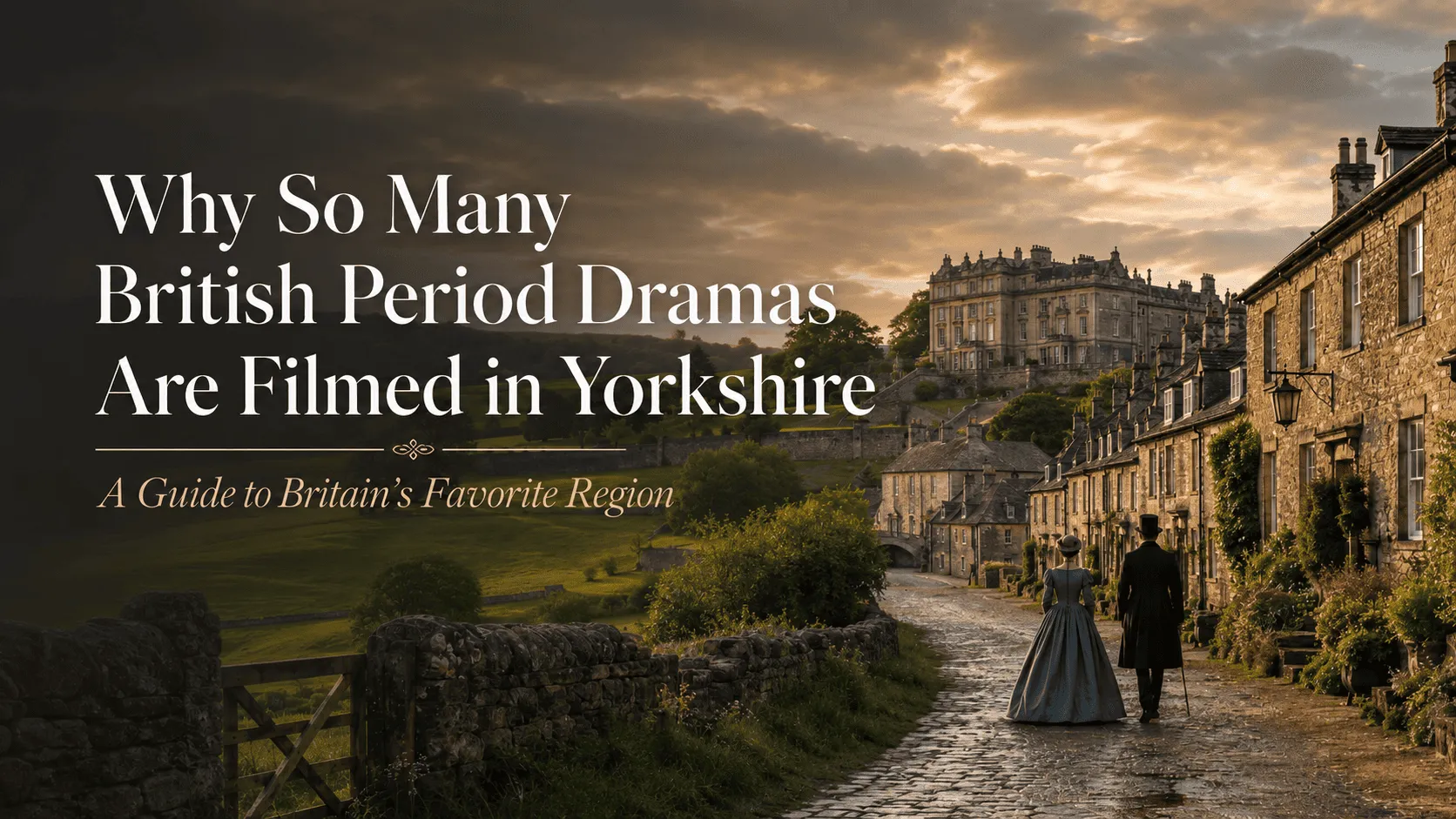
Cinematic wide shot of a baroque English country estate (Castle Howard style) at golden hour — dramatic formal gardens, ornate stone fountain in foreground, vast manicured lawns, dramatic clouds, no people, no readable signage. Mood of grand British period drama. NO TEXT, NO LOGOS. 16:9, 1200×675, editorial cinematic style.
If you’ve watched a British period drama in the last twenty years, you’ve probably watched Yorkshire pretending to be somewhere it isn’t. The county — stretching from the urban grit of Leeds and Sheffield up to the wild moors and dales of the north — has quietly become British television’s most reliable filming canvas. From Downton Abbey‘s exteriors to Gentleman Jack, All Creatures Great and Small, The Gallows Pole, Peaky Blinders, and a steady stream of Sunday-night Sunday-night BBC and ITV dramas, Yorkshire keeps showing up — often as itself, sometimes as a generic “Northern England,” occasionally even as continental Europe. Here’s why.
The Yorkshire Triangle
What location managers refer to informally as the “Yorkshire triangle” — roughly bounded by the Yorkshire Dales National Park to the north, the North York Moors to the east, and the post-industrial towns of West Yorkshire (Halifax, Hebden Bridge, Bradford, Leeds) to the south — packs an unusually wide variety of landscape and architecture into a relatively small geographic footprint. Within a 90-minute drive, a production can move from open moorland, to a stone-built mill village, to a medieval cathedral city, to a grand country estate.
For television budgets — which are tighter than feature film budgets by an order of magnitude — that compression matters. Yorkshire allows productions to shoot multiple distinct environments without breaking the bank on long unit moves.
The Country Houses
Wide shot of a Yorkshire Dales stone-walled field landscape at sunset — golden raking light, dry-stone walls dividing green pastures, distant farmhouse, no people, atmospheric.
Yorkshire holds an exceptional concentration of grand country houses, many maintained by the National Trust or English Heritage and most of them film-friendly. Castle Howard, the baroque estate near Malton, is the most famous — the setting for Brideshead Revisited in both its 1981 television incarnation and the 2008 film. Harewood House near Leeds has appeared in numerous period dramas. Burton Constable Hall, Newby Hall, Wentworth Woodhouse, and Bramham Park regularly stand in for Georgian and Regency-era estates.
These houses don’t only provide exteriors. Many have intact period interiors — dining rooms, libraries, drawing rooms, ballrooms — that productions can shoot in directly, dressing them rather than building sets from scratch. That’s a huge cost saver.
The Mill Towns
West Yorkshire’s former industrial towns — Halifax, Hebden Bridge, Bradford, Saltaire, Todmorden — offer something genuinely unusual: large-scale Victorian and Edwardian industrial architecture, still intact, in working towns. Stone mills, mill chimneys, weavers’ cottages, terraced streets that climb up valley sides. These have powered the look of Gentleman Jack (shot extensively around Halifax, including at Anne Lister’s real ancestral home, Shibden Hall), The Gallows Pole, This Is England ’86 and ’88, and parts of Peaky Blinders, which used Stanley Mills and a long list of West Yorkshire industrial sites to portray 1920s Birmingham.
The advantage these towns offer is that they look the part with very little dressing. Many streets in central Hebden Bridge or upper Halifax can be shot, lit, and framed as Victorian period drama with almost no set decoration beyond hiding the modern signage.
The Dales and the Moors
Detail shot of a weathered stone-built mill chimney rising above a Hebden Bridge-style West Yorkshire valley village — atmospheric overcast light, no people, atmospheric.
Beyond the houses and the towns, Yorkshire’s two national parks — the Yorkshire Dales and the North York Moors — provide the open landscape that has powered All Creatures Great and Small, Heartbeat, the 2009 film of Wuthering Heights, and innumerable other productions. The Dales’ dry-stone walls and stepped fields, and the Moors’ open heather and isolated stone villages, are visually iconic and largely unaltered.
All Creatures Great and Small, the Channel 5/Masterpiece adaptation of James Herriot’s books, films extensively in the Dales — primarily around Grassington, which doubles for the fictional village of Darrowby. Visit Grassington in autumn and you’ll still find traces of the production: shop frontages that occasionally get re-dressed as the Drovers Arms or Skeldale House for filming blocks.
York and Whitby
The cathedral city of York — with its intact medieval walls, the Shambles, and the Minster — has been used surprisingly sparingly for film and television, partly because year-round tourist crowds make street control difficult. When productions do shoot in York, they tend to use the Minster, the city walls, or specific carefully chosen streets early in the morning.
On the coast, Whitby — Bram Stoker’s inspiration for the Whitby that appears in Dracula, and a town whose abbey ruins genuinely look like a gothic novel cover — appears regularly in period dramas needing a Northern English fishing port.
Screen Yorkshire and Production Infrastructure
Wide shot of Whitby Abbey ruins on a clifftop at sunset — dramatic gothic stone arches, North Yorkshire moorland behind, no people, atmospheric.
The region’s success isn’t only landscape and architecture. Screen Yorkshire, the regional screen agency, has actively invested in productions through its Yorkshire Content Fund, supported crew training, and worked to keep the region’s freelance base employable. Leeds in particular has built up a respectable post-production and crew ecosystem, with Channel 4 opening a national HQ there in 2019 — a development that has had a noticeable knock-on effect on local production volume.
The result is that productions filming in Yorkshire can crew locally, hire local production companies, and lean on a regional pipeline that increasingly does not need to import support staff from London.
Why It Keeps Working
Yorkshire keeps showing up on screen for a few interlocking reasons. The landscape is unusually varied; the architecture is unusually intact; the crew base is unusually deep for a region outside London; the country houses are unusually welcoming to productions; and the local government and screen agencies are unusually motivated to keep productions coming.
For viewers, the practical effect is that when a Sunday-night drama promises Northern England, it’s often Yorkshire — and frequently the same five or six towns and estates being redressed yet again into a slightly different setting.
If You Want to Visit
- Grassington and the Dales: Best for the All Creatures Great and Small look, especially in summer and early autumn.
- Hebden Bridge and Halifax: The mill-town aesthetic; Shibden Hall in particular is open to visitors and is genuinely Anne Lister’s home from Gentleman Jack.
- Castle Howard: Open seasonally; allow most of a day.
- Whitby: Coastal gothic; combine with Robin Hood’s Bay for a half-day along the cliffs.
For more regional production deep-dives, see the rest of our Filming News archive.
Sources and further reading: Screen Yorkshire, Welcome to Yorkshire‘s tourism guides, and the National Trust’s listings for the country houses mentioned above.